
Dinosaurs
Plesiosaurus
Plesiosaurus
Classification and scientific name: Plesiosaurus dolichodeirus
Sources checked:
A long neck and four flippers: distinguishing a genus from all plesiosaurs
Plesiosaurus is a genus of marine reptiles, narrower than the entire plesiosaur group.
Origins and distribution
Early Jurassic European seas
- Plesiosaurus dolichodeirus
- Extinct animal studied through fossils
- Distinguishing reconstruction from evidence
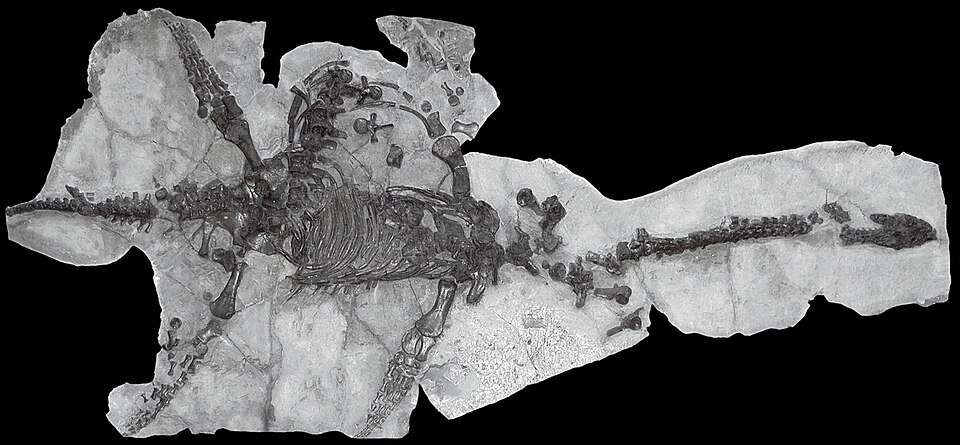
Fossil or skeletal specimen
Plesiosaurus fossil and skeletal exhibition material. Displays may include replicated or supplemented parts; this is not a photograph of a living individual.
Source: the paleobear · Original material: Plesiosaurus_dolichodeirus_NHM.jpg · CC BY 2.0
1. Classification, discovery and geological context
Plesiosaurus was a plesiosaurian marine reptile. Distinguish the whole plesiosaur group from the genus Plesiosaurus.
This page focuses on Plesiosaurus dolichodeirus from Early Jurassic European seas. It is important in the history of British fossils and early palaeontology. The broader group contains many animals with different neck-to-head proportions, so distinguish the general group name from this genus. Although it lived in the seas of the dinosaur era, it was not itself a dinosaur.
2. Appearance and identification
A long neck, small head and four flipper-like limbs are characteristic.
A long neck extends from the small head, with four large flipper-like limbs beside a broad torso. The tail differs in proportion from the long neck in the overall outline. Neck movement is studied within the range permitted by bony joints, allowing comparison with older illustrations showing great swan-like flexibility. Reconstructed underwater postures combine preserved bones with functional interpretations.
3. Evidence for ecological interpretations
Plesiosaurus used underwater food resources, and movement of its four limbs is studied through anatomy and models.
Pointed teeth and jaws support interpretations of predation on small marine animals. Hydrodynamic and other models investigate the sequence in which the four flippers moved. Do not copy the movements of living sea turtles exactly, and require separate evidence for scenes with the neck raised high above water. Possibilities from fossil analysis differ from actual underwater footage.
4. Limits of the fossil record and reconstructions
These fossils reveal marine-reptile life, understood separately from dinosaur categories of carnivory and herbivory. Do not explain an extinct animal through modern pet-care methods.
Skeletons in marine sediments reveal burial after death as well as where the animal lived. In museums, check whether the specimen's name is Plesiosaurus or another plesiosaur. This page shows fossils or scientific reconstructions and does not use legendary lake-monster photographs as biological evidence. Compare how proportions vary even among species sharing four flippers.
Evidence and references
- Natural History Museum — Plesiosaurus
Classification, origin, appearance and ecology
- Natural History Museum — Mary Anning
Plesiosaurus fossil discoveries and early marine-reptile research